Psychedelic assisted psychotherapy
I have been following the progress of PAP for some years since I first attended a lecture by Prof. David Nutt at least a decade ago. It is a tragic irony that the development of this loosely grouped substances and their utilisation for therapy was blocked comprehensively for about 50 years while the development of strategic nuclear weapons continued at pace.
It is tempting to suggest that the inexorable deterioration in weather patterns, from the careless discharge of millions of tonnes of additional CO2 and methane into our atmosphere and the actions of one malevolent dictator, threatening the use of nuclear weapons, (which would spark a nuclear winter) are explanation enough for the general disquiet, (labelled mental “illness” in (mainly) first world societies.
However the progressive darkening of our collective “zeitgeist” has more pervasive, less dramatic origins, I suggest.
My aim to offer a perspective today, which I’m more than happy to be contested. I apologise for my impaired delivery but I hope I can offer a coherent basis for why the use of psychedelic-assisted therapy may be not only imminent but essential.
Firstly I will cover the development of P.A.P in our region and what you might expect to encounter in the next decade, working in Mental Health and AOD field.
I get into conversations with clients about psychedelics approximately weekly. Many have heard of the trials of micro-dosing with LSD at Auckland Uni and the ketamine-based therapy available through Anteris…. (A trial to treat alcohol dependence with a single dose of ketamine is currently being recruited for.)
I was told by a client last week, someone who has been disabled by polydrug use, anorexia and borderline behaviour patterns for twenty years, that she had bought a pound of dried mushrooms, (.45kg.) and was working her way through 3-4g every other day. She sounds well and happy for the first time.
Secondly I will offer a point of view about the origins of, what we are told is an epidemic of mental unwellness and of substance dependence, in particular. Follow the link below for further information on the current situation in our part of the world
https://theconversation.com/why-the-tga-should-reschedule-mdma-and-psilocybin-for-the-treatment-of-mental-illness-160276#:~:text=On%20February%203%2C%20the%20TGA%20announced%20an%20interim,for%20abuse%2C%20and%20lack%20of%20suitably%20trained%20psychiatrists.
Psychedelic-assisted Psychotherapy. Lecture notes
In November of this year I attended an online conference hosted by an organisation called Mind Medicine Australia. It is a privately funded charitable organisation, dedicated to leading the development of a psychiatric treatment regime using psychedelic substances.
Their efforts are directed towards;
1) Canvassing the Australian Pharmaceutical Regulation and Classification body, the TGA,(THERAPEUTIC GOODS AUTHORITY), to change the scheduling of some psychedelic drugs so that they can be tested and evaluated.
2) Training a workforce, and developing protocols in preparation for the time when psychedelics can be used in treatment sessions.
3) Publicising the benefits of this treatment, in comparison with currently used “conventional therapies.”
It maintains and nurtures relationships with leading researchers around the world and many eminent academics in the field have been appointed “ambassadors” for MMA.
MMA was the “brain-child” of an energetic, determined couple, Tania de Jong, (AM), and Peter Hunt,(AM).(Member of the Order of Australia) who are enthusiastic psychonauts and “social entrepreneurs”. Their personal experiences and the enlightenments achieved have motivated them to make these substances available through mainstream legitimate mental health services.
Tania is a Dutch Jew ,( who believes her trauma was the result of epigenetics and her ancestors experience of persecution, an accomplished soprano and “creative alchemist” and Peter is described as a philanthropist and investment banker.
They are both passionate about the organisation and its goals.
Mental Health. (“An urgent and serious need”).. Tania de Jong.
The incidence of depression, anxiety has been increasing steadily over the last forty years.
WHO data:
..between the years 1990 and 2013, the number of people suffering from anxiety and depression increased to 615 million from 416 million, which equates to an almost 50% increment. Nearly 10% of the global population is affected, with mental illnesses making up 30% of the world’s non-fatal disease burden.
20% Australian adults have chronic mental illness.12% are on antidepressants including 25% of Australians over 60 years of age. ( 18% increase in past five years) 95% increase in last 15 years.
More than 45% will experience mental illness in their lifetime.
A 2016 WHO study concluded that anxiety and depression disorders cost the world as a whole nearly US $1 trillion every year yet $4 trillion was made by pharmaceutical companies to ‘treat’ these diseases
There have been no significant advances in treatment for the last fifty years and even the substances being considered now were all described in the first half of the last century,
The Origin of Mental “Illness”. The Pernicious Influence of Early Trauma.
I credit Gabor Mate with this hypothesis, or “model”
The human infant has an extremely long period of dependence and helplessness. To ensure they remain protected they need secure attachment to, ( at least), one capable adult, on whom ,they instinctively understand, they are reliant. Secure attachment is. primary survival need.
A second “need” can be labelled “authenticity”, ie, feeling able to “trust their gut”.. When threatened, they are wired to respond automatically and they need to believe that their automatic reaction was the right response and build trust in their judgement.
But what happens if their response is not acceptable to their attachment figure.?
If they detect that their automatic reaction causes irritation and threatens their protection, they will sacrifice authenticity, in return for retaining the approval of that protector and will continue to adjust their behaviour to what they perceive to be expected. But this is not always obvious, may not get consistent results. Uncertainty becomes anxiety.
The amygdala, that nugget in the base of the brain, is the area that processes reactions to threat, (flight or freeze, resisting is rarely an option). It lights up then dims slowly as the crisis passes. If it is not resolved ,with appropriate soothing, the amygdala remains aroused and continues to flood the system with stress hormones and this is experienced as anxiety ..prolonged fear.
If this hyper arousal persists the amygdala remains habitually hyperactive and hence the infant experiences chronic anxiety. This is disabling, distracting and impairs cognitive performance. As it self-perpetuates it eventually progresses to a label of depression and substance, (or behavioural ), addiction.
( on the way, they are likely to attract other interim labels, oppositional defiant disorder, attention deficit hyperactivity disorder, dyslexia)
In its mildest form it results in poor self-esteem,(self image), low self-confidence, (self efficacy), social phobia and imposter syndrome.
Behavioural traits, become exaggerated and impede social development and there is strong possibility of a diagnosis of personality disorder.
Inadequate attachment and PTSD.
Parenting, providing 24/7 attention to infant’s needs requires an absolute, selfless, commitment.As a species we have lived and thrived as small communities with common goals. Parenting was shared between multiple adults. We have not adapted to the suburbanisation that followed the industrial revolution.
Supports that have evolved are inequitably distributed, to the higher decile areas, where they can afford them.
A common history amongst most of those with this narrative is that they describe re-experiencing, in some format ,distressing episodes, whether it be re-imagining specific events or just the associated evoked emotions.
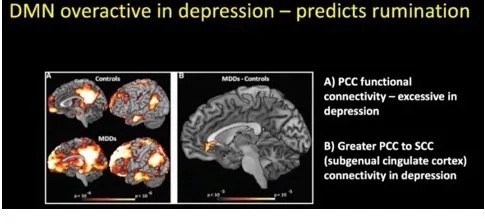
This is highly correlated with a propensity to ruminate,,to experience an internal monologue which is persistent and negative and becomes conscious when the brain is not distracted with other more complex tasks… see default mode network
So the bundle of remembered, and “ re-experienced”, frightening episodes, whether it be a single terrifying event, or a countless number of abusive events, both observed and endured,,this narrative history is the product of an incompletely resolved memory.. it evokes an unmodulated fear which leads to the desire to self-medicate.
This is a post-traumatic stress disorder
So, QED.
Excluding degenerative disorders, psychotic disorders and other wiring problems like autism spectrum disorder., Axis I disorders can be characterised as PTSD. ( from infant neglect to battle fatigue.)
The intensity of the recollection exceeds the ability to deal with it.
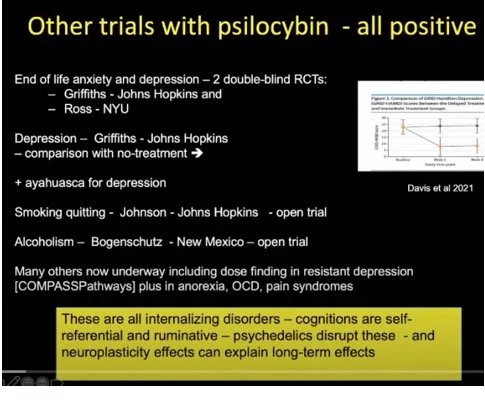
And psychedelic assisted psychotherapy works.
MDMA and PTSD.
There are two subtypes of PTSD.
Nondissociative.
The amygdala is chronically over active and the prefrontal cortex is underactive
Dissociative.
Considered even harder to treat with conventional therapy. The amygdala is underactive, and the cortex overactive, causing emotional numbing and fragmentation of personality.
https://www.nature.com/articles/s41591-021-01336-3
This is a link to the study which established the effectiveness of MDMA with certainty.
Phase 3. Randomised, double blind, placebo controlled study.
The study used a rigid protocol, extending over 18 weeks.It used three medicated sessions interspersed with three session of preparation before the first then three sessions of integration between each dose.
Slide on protocol
37%, placebo group no longer met criteria at end of trial
67% of the medication group responded and a further 21% made significant gains.
Both types responded and the change was sustained .
Mechanism of Action of MDMA
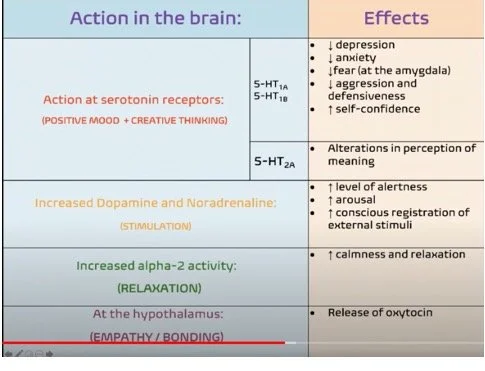
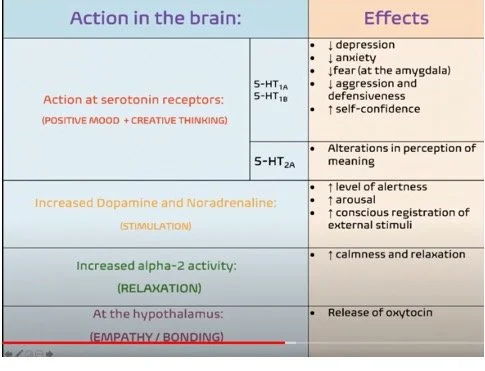
MDMA acts on at least three separate systems. Firstly it is partially active at the 5-HT 2a receptor, it increases the release of serotonin and is variably psychedelic,. The amphetamine part stimulates the norepinephrine pathways and it releases oxytocin, the sum effect being, a bit trippy, quite stimulating and relaxing at the same time.
Slide on mechanism of action
There are reported to be 3-400 private companies working on development of a commercial product, challenging patents, synthesising new analogues. Said to have raised $1.5 billion US.
Risk is that these companies are focussing on the medication, not the therapy. It is likely there will be a backlash when these inappropriate regimes return a bad record of responses.
MDMA and Alcohol Dependence.
Pilot study..
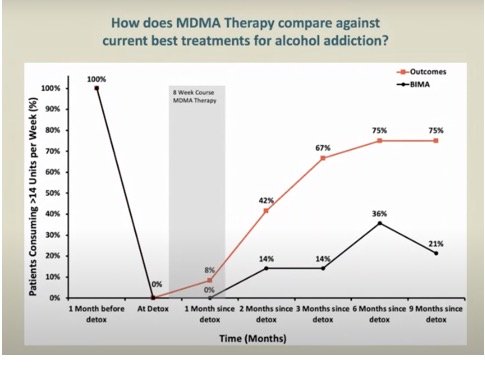
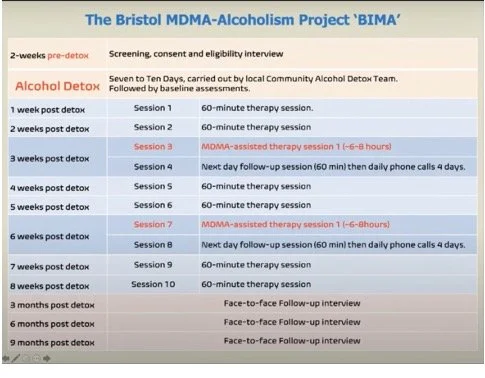
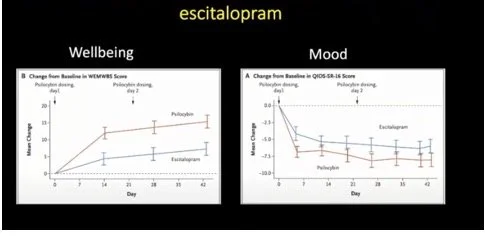
This was an open label study to establish safety and tolerability. It involved only 14 subjects recruited from local drug treatment centre.
difference in results were striking. Furthermore there was no "come down" after the treatment in fact people's mood remained relatively elevated.
The Default Mode Network.
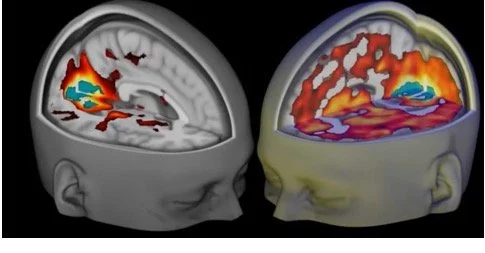
David Nutt’s group at Imperial College have led the world in functional MRI imaging to elucidate the effect of the tryptamines namely psilocybin, because its half life is manageable. Ibogaine and Ayahuasca are in the same group but unpleasant to take.
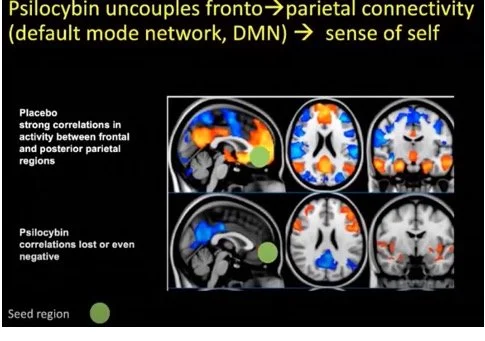
The DMN is a “circuit” between the anterior and posterior cingulate gyra and also includes a parieto-temporal component. It is most active when the owner is at rest, day-dreaming or ruminating. It is what the brain does when there is no more urgent demands for its attention.
It is the location of the sense of self, the “ego”, the internalised conception of who we are.
It is the notional nidus of the classic negative commentary..” I’m a failure, everybody knows I’m a failure, “ etc.
It is the nagging negative internal monologue that leads people too seek relief by self-medicating with intoxicants.The severity of depression correlates very well with the intensity of rumination and that correlates with hyperactivity of the DMN.
For example, the unresolved trauma of PTSD will replay when the brain is resting.
Psilocybin blocks the function of the DMN and results in stimulation of the 5HT2A receptors.
These receptors are recent arrivals in the evolution of the mammalian brain and are most concentrated in the “level 5”.pyramidal cells in the deep cortex. The decreased connectivity of the DMN leads to the reduced processing of incoming sensory stimuli and it is suggested that it is perceived in un filtered, primitive form, eg the visual patterns approximate those seen by infants
The Perils of “Higher” Consciousness
I struggled manfully to mine the terabytes of weapons-grade bullshit written about the nature of consciousness. ,(which the French call “conscience”)
After trying to pronounce, let alone understand words such as “epiphenomenalism” and “eliminativist”
This is how one such paper concluded..
The buttock, however, in man, is different from all animals whatsoever. What goes by that name, in other creatures, is only the upper part of the thigh, and by no means similar.
George Louis Leclerc de Buffon (1792, pp. 80–81)
Why do people think? Why do they calculate the thickness of walls of a boiler and do not let the chance determine it? Can a calculated boiler never explode? Of course, it can. We think about actions before we perform them. We make representations of them, but why? We expect and act according the expectancy;… Expectancy [is] a preparatory action. It outstretches its arms like a ball player, directs its hands to catch the ball. And the expectancy of a ball player is just that he prepares arms and hands and looks at the ball.
Ludwig Wittgenstein (1996, pp. 109, 139)
I wonder if the issue can be viewed much more simply..All the complexity of morality and mortality and how they interact can be assumed to be due to basic human instinct.. the drive to survive and in particular a fear of death, the dreaded end.
Ubiquitous and consistent across all the, otherwise diverse ,cultures of the world have developed organised religious rituals in the service of, superhuman, ( and therefore unseeable), all seeing beings, who promise, if one is adherent to the rules, the avoidance of termination.
Some of these rituals have used psychedelic experiences as a normal part of their religious practice.
Buddhist meditation practices, focussing on “letting go” of negative thoughts by distancing from them and examining them critically, has been adapted and is advocated widely in Western mental health practices. This occasionally leads to an ecstatic experience that the person experiences as, at least, a major new insight and lasting change of perspective, and often as a mystical, spiritual experience, which emphasises connectedness and a feeling of “oneness” with the w orld..
Some Western, Christian traditional churches put considerable emphasis on the ecstatic experience, when during feverish group worship, the person is entered by God, or his understudy.
I believe these similarities are examples of human behaviour evolution aimed at a spiritual elevation, reassurance of the existence in a “higher consciousness” and it is the same experience that is caused by psychedelic substances, obviously vastly more efficiently and predictably.
Bill Richards, the doughty veteran of Johns Hopkins, who has devoted his life to researching psychedelics.. has surveyed online volunteers to answer questions, about their spiritual beliefs and found that there was a two point up-tick, (on scale of 1:10), after a psychedelic experience, in mystical beliefs; for example, being open to possibility that objects previously considered inanimate, may be conscious.
This emphasis on mystical experience, is shared by many of the most enthusiastic promotors of PAP. Bill Richards d3voted one of his sessions to the choice of background music for the session ( Brahms is preferred)… Tania de Jong AO promoted a CD of her self singing opera.
It remains a moot point whether by taking the trip out of the spiritual underworld, you can keep the spirit world out of the trip.. I think not..
The New World.. who will be the Brave..
Point 1.
The cultural zeitgeist insists that we are becoming unhappier. Politicians and parents clamour for better outcomes in our “mental Health” statistics.
In fact nothing new has been introduced in fifty years or more and results of these treatment approaches are modest and nobody is fooled.
The increase in “mental health problems” is an increase in “life distress”
Namely anxiety, depression, resultant substance abuse, behavioural addictions, cluster b. Personality “exaggeration”.
These conditions can all be conceptualised as PTSD, namely the residual distress and dysfunction from inadequate attachment and home circumstances in the pre-conscious brain, in particular the midbrain and amygdala, where memories which are inaccessible later in life , of experiences which frightened and in the long term created unbalanced pathways to the prefrontal cortex,
These pathways are largely inaccessible and immutable by any other treatment modalities,,
That these events are not amenable to change because of intergenerational transmission of parenting plus unchangeable social circumstances.
How can this new approach to therapy be ignored..it won’t be.
What should we do..
Focus on Mdma.